
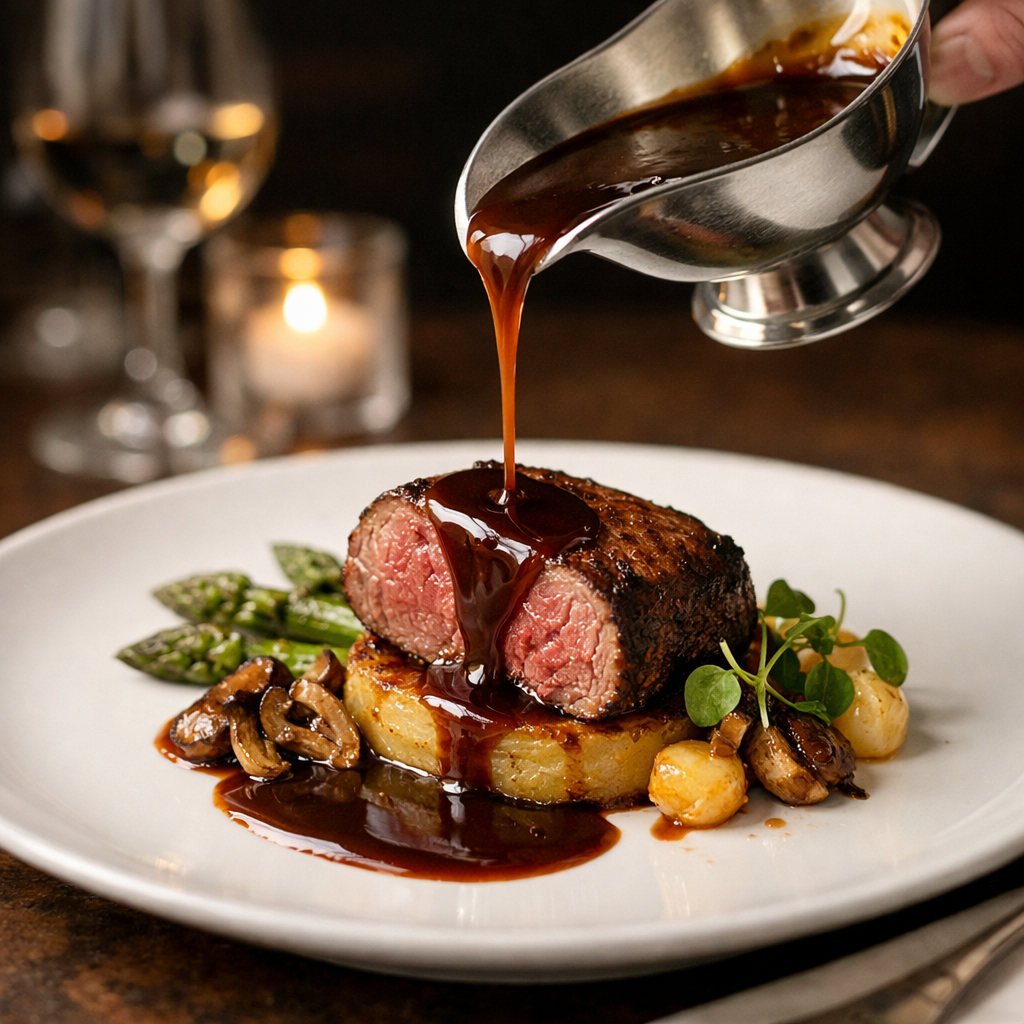
A sauce is often spoken of as though it were an optional luxury, something added at the end to elevate a plate or make it restaurant-like. This view misses its actual function. A good sauce does not simply decorate food. It organizes it. It creates cohesion between elements that would otherwise remain separate. It introduces contrast where the dish is too uniform, and it controls how flavor is distributed across the palate. In many meals, the sauce is not the embellishment but the principle of coherence. It changes everything because it changes the relationships within the dish.
Without some binding element, even good ingredients can remain isolated. A grilled vegetable, a grain, and a protein may all be properly cooked, yet still feel disconnected when eaten together. A sauce gives them a common language. This does not require something elaborate or classical. A dressing, broth, pan reduction, yoghurt mixture, herb oil, tahini emulsion, salsa, or butter-based finish can all function as sauces in this broader sense. Their purpose is not merely to add moisture but to regulate how the plate behaves. They tell the eater how the elements are meant to be encountered together.
Cohesion is only one part of what makes sauce important. The other is contrast. Many dishes fail not because they lack ingredients, but because they lack a counterforce. Roast foods need brightness. Fried foods need sharpness. Lean foods need lubrication. Rich foods need relief. Dry starches need movement. Sauce provides this correction. A spoon of salsa verde beside roast meat, a lemon-butter glaze over fish, a yoghurt dressing under charred vegetables, or a sharp vinaigrette over grains does more than add flavor. It solves imbalance. It inserts what the dish itself cannot generate alone.
This is why the best sauces are not generic. They are specific responses to the needs of a particular dish. The right question is not “what sauce goes with this?” but “what does this dish lack?” If the plate is rich, the sauce may need acid and herbs. If it is lean, the sauce may need fat and softness. If the ingredients are sweet and earthy, the sauce may need bitterness or spice. If the dish is already intense, the sauce may need to quiet rather than amplify. Good saucing is therefore not about memorizing pairings. It is about diagnosis.
Sauce also controls pacing. Dry foods require more chewing and can become tiring if every bite demands the same effort. Sauced foods move differently. They coat, soften, extend, and carry. This alters how long flavors remain in the mouth and how quickly the palate fatigues. It is one reason why a plain grilled chicken breast and the same chicken with a well-made pan sauce feel like entirely different meals. The protein itself has not changed. What changed is the medium through which it is perceived.
There is a technical lesson here as well. A good sauce teaches control. It teaches reduction, balance, emulsification, thickness, and restraint. A sauce that is too thick can deaden a plate. Too thin, and it disappears. Too acidic, and it dominates. Too fatty, and it slows everything down. Too sweet, and it becomes blunt. To make a sauce well is to understand proportion under pressure. The process rewards tasting, adjustment, and attention to temperature. It is one of the clearest expressions of cooking as calibration rather than mere assembly.
This is also why simple sauces are so instructive. A vinaigrette reveals the balance between acid and fat. A yoghurt sauce shows how dairy can cool and carry spice. A pan sauce demonstrates how residue, stock, butter, and heat can become elegance from almost nothing. A herb oil teaches that aroma can be distributed rather than confined. These preparations are useful not because they are fashionable, but because they are transferable. Once understood, they can be adapted endlessly. The cook becomes less dependent on exact recipes and more capable of building coherence in real time.
Historically, sauces often emerged from necessity as much as refinement. They stretched flavor, moistened dry foods, redeemed scraps, and unified humble ingredients. A sauce could turn a basic plate into a satisfying one not through disguise, but through integration. In this sense, sauce is one of the great technologies of the kitchen. It makes separate things feel intentional together. It is both practical and aesthetic, both structural and sensory.
For home cooks, learning to think in sauces is transformative because it increases range without requiring constant novelty. You can cook the same vegetables, grains, and proteins repeatedly and make them feel different through the sauces that accompany them. Tahini with lemon gives one direction. Brown butter and capers give another. Ginger-scallion dressing gives a third. Herbed yoghurt gives a fourth. The ingredients remain familiar, but the relationships shift. This makes everyday cooking more sustainable because variety comes from interpretation rather than endless procurement.
A well-made sauce also communicates care. It suggests that someone considered not only the ingredients but their interaction. It is often the element that makes a meal feel composed rather than merely cooked. Even a very simple dish can carry this feeling when its sauce is appropriate, balanced, and intentional. The sauce says that the plate has been thought through.
In the end, a good sauce changes everything because it changes how everything else belongs. It binds, corrects, extends, and clarifies. It turns parts into a dish. It makes flavor move with direction rather than accident. And while it may appear on the plate as a liquid, it functions more like an argument: this is how these ingredients are meant to meet. When that argument is sound, even the simplest meal feels complete.
Leave a Reply