
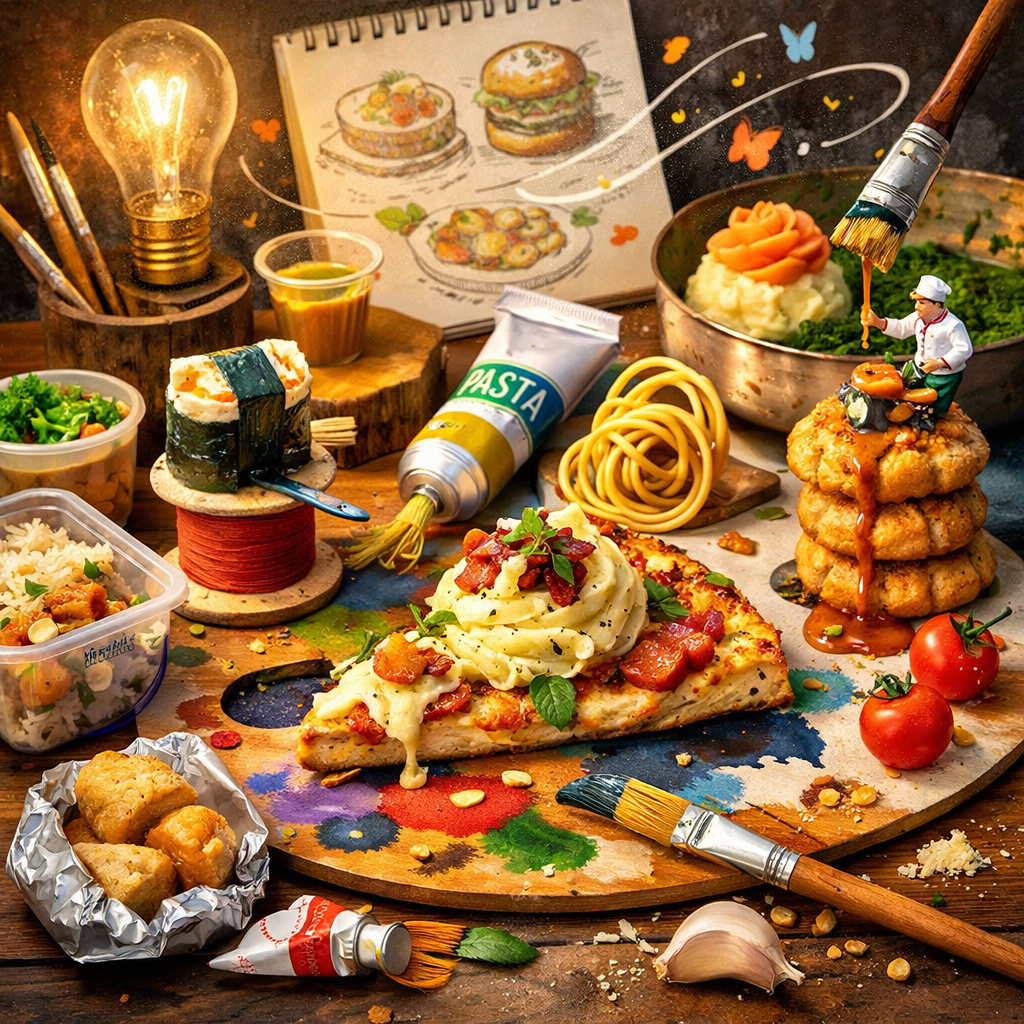
Leftovers are often treated as evidence of incompletion. They are what remains after the “real” meal has ended, a residue of planning, excess, or necessity. In many kitchens, they are tolerated more than valued. Yet this view misunderstands what leftovers represent. Properly understood, leftovers are not failed freshness. They are ingredients that have already entered the logic of the kitchen and can now be redirected with greater efficiency and often with greater depth. Repetition in cooking is not the opposite of creativity. It is one of its most practical forms. The intelligence of leftovers lies in their capacity for reinvention.
A cooked ingredient is not the same thing as a raw one. It has already undergone transformation. Moisture has shifted. Flavor has concentrated or mellowed. Texture has softened, tightened, or relaxed. This means leftovers do not simply repeat the original meal. They offer a second stage of possibility. Roast vegetables can become soup, grain bowls, fillings, pasta sauces, or dressed salads. Braised meat can become sandwiches, fried rice, croquettes, or broth enrichments. Cooked rice can become stir-fried, pan-crisped, or folded into soups. These are not emergency solutions. They are distinct culinary pathways that only become available after the initial cooking.
The psychological resistance to leftovers often comes from a narrow understanding of repetition. People assume that eating leftovers means eating the same plate twice. That can indeed feel uninspiring. But repetition need not be literal. In good kitchens, repetition is structural rather than visual. The same base ingredient appears again, but in a different form, at a different temperature, with a different texture or seasoning direction. This transforms familiarity into continuity rather than monotony. Instead of feeling trapped by what remains, the cook develops a relationship with it.
Leftovers also force clearer culinary thinking. When ingredients are already cooked, the cook can no longer rely on elaborate preparation to create interest. The question becomes more direct: what is this ingredient now capable of doing? A cold potato is no longer a side dish by default. It may be crushed and crisped, folded into eggs, dressed with mustard, or turned into a filling. Leftover roast chicken may no longer function best as carved protein. It may work better when shredded and paired with acid, herbs, and crunch. These decisions require interpretation. The cook is not following the original intention of the dish, but reading its second potential.
This is where leftovers teach adaptability. They shift cooking away from fantasy and toward observation. You stop cooking from an idealised image and start cooking from what exists materially in front of you. That roasted pumpkin has softened. The rice has dried slightly. The lentils are thicker than yesterday. The fish is too delicate to reheat aggressively. Each of these conditions suggests a different route. The cook who pays attention learns to work with change rather than against it. In this sense, leftovers are a training ground for judgment.
There is also an economic and ethical dimension that should not be reduced to moral language alone. Using leftovers well is not simply about avoiding waste, though it certainly does that. It is also about respecting the work already done. Time, heat, ingredients, and attention have already been invested. To ignore that and start again unnecessarily is often less rational than transforming what is available. A leftover-aware kitchen is usually a more efficient kitchen, but also a more thoughtful one. It values continuity. It treats meals as part of a sequence rather than isolated performances.
Many traditional cuisines already understand this. Some of the most beloved dishes in the world are fundamentally second-life foods. Fried rice, stews enriched over days, soups made from bones and scraps, breads renewed as puddings or salads, sauces revived with last night’s roast, pickles from surplus produce, and fillings made from prior meals all reflect the same principle. Culinary history is not a history of pristine first uses alone. It is equally a history of extension, adjustment, and return. The endurance of these dishes shows that reinvention is not a lesser culinary act. It is often the more intelligent one.
Leftovers can even improve flavor. Resting allows ingredients to absorb seasoning more fully. Braises deepen. Soups settle. Sauces become more unified. Marinated dishes often taste better the following day. This is not merely convenience; it is chemistry and time working together. A cook who understands this stops seeing freshness as the only marker of quality. Some foods peak only after pause. The leftover is not always a diminished version of the original. Sometimes it is the dish in a more complete state.
For readers and home cooks, this perspective is liberating. It reduces pressure. Every meal no longer has to be final and perfect in one sitting. Cooking becomes cumulative. A pot of beans may begin as dinner and continue into lunch, soup, spread, or salad. A tray of roast vegetables may appear first as a side and later as the basis of another dish entirely. This way of thinking builds confidence because it lowers the stakes of singular outcomes. Nothing has to carry the entire burden of one perfect meal. The kitchen becomes more fluid and forgiving.
Ultimately, leftovers reveal a quieter form of intelligence in cooking. They reward memory, restraint, and reinterpretation. They teach that culinary value does not reside only in novelty. It can also reside in continuity handled well. Repetition becomes meaningful when it is transformed by attention. A good cook does not merely produce meals. A good cook extends them, redirects them, and understands when a dish has not ended but changed phase. Leftovers are not the afterlife of cooking. They are part of its ongoing thought.
Leave a Reply